28 February, 2012

【Spring Flower Series】 Awaji Hanasajiki and raped flowers


“Awaji Hanasajiki”(Awaji Flower Garden) is one of the best flower viewing sites in Hyogo. This garden is four times as large as the Hanshin Koshien Stadium or approximately 14.6 hectares with seasonally blooming flowers. Visitors can enjoy the panoramic view of more than 2.5 millions of charming flowers in bloom against the background of the Akashi Kaikyo Bridge and the Osaka Bay.


“Hanana” or the raped flower is one of the most beautiful in spring. It starts to bloom in early March and is in full-blown in April. When it comes to the rape flower field, many Japanese are very familiar with the image of a landscape or a field covered with yellow raped flowers. Awaji Hanasajiki grows purple raped flowers as well as yellow ones. More than one million of both colors of raped flowers are planted in total. The carpet of both flowers together shows a lovely contrast of yellow and purple and it is really beautiful to view.

Carpet of raped flowers

20 February, 2012

Title: Kiyomori Chaya (CAFE Kiyomori), OPEN!


Last month, “Kiyomori Chaya (CAFÉ Kiyomori)” opened! The café is open on Saturdays, Sundays and national holidays in four places: The temples Nofuku-ji, Shinko-ji and Yakusen-ji as well as Wada Shrine in Hyogo Ward, Kobe City. Each of these four places has a deep connection with Taira no Kiyomori (see the last three articles about Taira no Kiyomori).
Visitors can make themselves comfortable while enjoying the unique atmosphere of a typical Japanese Chaya (café).

At “Kiyomori Chaya (CAFÉ Kiyomori)” in Nofukuji-temple.

At “Kiyomori Chaya (CAFÉ Kiyomori)” in Nofukuji-temple.


13 February, 2012

“Taira no Kiyomori” the Historical Museum


The NHK drama, “Taira no Kiyomori,”has proven very popular in Japan since it was first aired.
We introduced “Taira no Kiyomori: the Drama Museum”, which opened on 21st January, in our last issue. Another new exhibition pavilion, “Taira no Kiyomori: the Historical Museum,” opened on the same day in the same area. 

This historical museum is located near the Shinkawa Canal in Hyogo Ward, Kobe.
Once there was an old and historical port which was repaired and improved upon by Taira no Kiyomori. This port was called “Owada-no-Tomari.” The modern port of Kobe was developed on the foundations of what used to be “Owada-no-Tomari.”

Kiyomori used this old port as the base to establish and expand a trade relationship between Japan and the Sung dynasty of China. He is inseparable from this area when we think about the history of Japan.

“Taira no Kiyomori: the Historical Museum”


31 January, 2012

The new exhibition pavilion for “Taira no Kiyomori”


 This issue introduces a new attraction in Kobe related to the new NHK drama, “Taira no Kiyomori,” which came on air in January 2012. Along with the launch of the new drama, the “Taira no Kiyomori Drama Museum” opened on 21st January so that visitors can experience the world of the NHK drama.

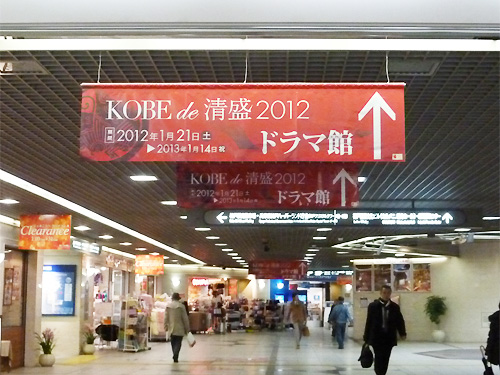
When you get off at JR Kobe Station and go down the escalator to the underground malls, you will find banners like the one in the photo below. Walk straight ahead and you will find another escalator. The entrance to the drama pavilion will come into sight as you go up the escalator.

Banners near JR Kobe Station

The entrance of the Drama Museum


The entrance of the Drama Museum

 Let’s go inside the museum!

 Matsuyama Ken’ichi, who starred in a movie called “Norwegian Wood,” plays the main hero Kiyomori. Numerous objects like photos of the cast, introductory information about the characters, costumes, scenic art and other items are displayed at the second exhibition corner called “Taiga Drama Information Zone.”

One of Kiyomori’s outfits


Clothing belonging to Tokiko (Kiyomori’s wife)

In the late Heian period (approximately 830 years ago), Kiyomori relocated the Japanese capital city from Kyoto to “Fukuhara-kyo” (Hyogo Ward, Kobe City). An accurate diorama and elaborated computer graphics at the corner of “the Lost Capial of Fukuhara-kyo Zone” are on display to reproduce the Fukuhara-kyo area, helping to reveal to the viewer the new capital Kiyomori dreamed about. Enjoy traveling back to old Kobe in the late Heian period.

Diorama of Fukuhara-kyo

 There is a special area for taking commemorative photographs with a life-size figure of Kiyomori (played by Matsuyama Ken’ichi in the drama) at the “Young Kiyomori” Zone. Matsuyama himself said that the figure bares a striking resemblence. Don’t miss this memorable photo-op with the figure! It will be your only chanceto take such a precious photo this year.

Commemorative photo corner 

 Near the exit is a gift shop selling official goods of the NHK drama “Taira no Kiyomori” and souvenirs of Kobe. All products sold at the shop including sweets, T-shirts and goods printed with official logos, are limited editions that are only available here.

 Why not visit this museum? The displays are sure to fascinate all visitors! This pavilion is the very exhibition for you if you love Japanese history or samurai warriors.

 “Taira no Kiyomori”: the Drama Museum
Venue: Harborland Center Building (Higashi Kawasaki-cho, Chuo-ku, Kobe)
Date: January 21st (Sat), 2012 – January 14th (Mon), 2013
Time: 900 - 1700Last admission at 1630
Access:  5 minute walk from Harborland Stn., Municipal Subway Kaigan Line
        5 minute walk from JR Kobe Stn.
        8 minute walk from Kosoku Kobe Stn., Kobe Kosoku Line
Admission: Adults ¥600 (the Drama Museum only), \700 (a ticket set for both the Drama Museum and the Historical Museum); Primary & Junior high school students ¥300 (the Drama Museum only), \350 (a ticket set for both the Drama Museum and the Historical Museum)

Useful links :
KOBE de Kiyomori : The Drama Pavilion: http://kobe-de-kiyomori.jp/dorama/ (Japanese)
Information page for the Drama Museum and the Historical Museum :http://www.hyogo-tourism.jp/english/whatsnew/index.php?id=339 (English)

 Our next issue will be on “Taira no Kiyomori” Historical Museum. Don’t miss it!


HanaHyogo Tourism Association)


20 January, 2012

What's Taira no Kiyomori?


 Many Japanese people look forward to watching Taiga dramas (or “big river” drama), which are broadcasted by NHK. These annual dramas centre on historical figures who from a critical juncture of Japan’s history and often have a great influence on tourism to towns related to the characters or settings of the dramas themselves. It is very similar to the way many people visit Rome to travel to the settings of the movie “Roman Holiday.” The 2012 drama is about Taira no Kiyomori. He is closely connected with Hyogo-Kobe, a fact that stimulates local tourism greatly. So, who is he?


Who is Taira no Kiyomori?


 Taira-no-Kiyomori was a samurai warrior in medieval Japan (approximately 900 years ago). He was the first samurai in history to take a political place among Japan’s nobility, thereby establishing a samurai-dominated administrative government in Japan. He is often described as a villain or an anti-hero in a famous piece of Japanese classical literature, “the Tale of Heike.” After Kiyomori and his clan won a deadly battle against another samurai clan, all of Japan came under his rule and his family and the members of his clan kept all the important posts in the government to themselves. They placed too much confidence and pride in their own power and ability, and as time went by, they fell down from their proud existence of glory and elegance. However, Kiyomori was also an innovative harbour and urban planner with a good sense of economy and internationality. Kiyomori’s clan improved the old port in Kobe (“Owada-no-Tomari”) and its surrounding area as one of their bases. He dedicated his life to enriching the country by international trade; he prepared and improved the trade infrastructure of the old port and laid the foundations of full-scale international trade, including construction of an artificial island. He established a trade relationship with the Sung dynasty of China and put imported Chinese coins into public circulation, bringing about a money economy in Japan. He relocated the capital from Kyoto to Fukuhara, present-day Hyogo Ward in Kobe. Nonetheless, the new capital stayed just for less than half a year before being returned to Kyoto again due to various reasons.
 The frustration with the dictatorship of the Taira clan was growing among the nobility, temples, shrines and other samurai clans. Kiyomori died of a fever while his inveterate enemy, the Genji clan, rose up in arms supported by an anti-Taira clan movement. His ashes were buried in a temple in Kobe. Thus, Kobe has been closely connected to Kiyomori, and many sites in Hyogo Prefecture keep historical treasures left by Kiyomori and his clan.

The Great Buddha of Hyogo sitting at the temple where Kiyomori became a priest

 People pay a lot of attention to any city or town which provides the setting for any NHK Taiga drama. These locations come to be the central attractions of tourism in the area. Hyogo will take this opportunity to promote places of interest related to Taira-no-Kiyomori.


 Our next blog will introduce a new exhibition pavilion in Kobe which is connected to the NHK drama "Taira no Kiyomori." Don’t Miss it!


Useful links:

Hyogo Tourism Guide
http://www.hyogo-tourism.jp/english/column/2009_04_tid.html (English)
http://www.hyogo-tourism.jp/english/hyogotsu/index.html (English)

Taira no Kiyomori
http://www.hyogo-tourism.jp/aitaihyogo_2011/ (Japanese only) .
http://www.kiyomori-genpei.jp/ (Japanese only) 
http://feel-kobe.jp/genpei/nagare04.html (Japanese only)

KOBE de Kiyomori
http://kobe-de-kiyomori.jp/ (Japanese only)

NHK Official Drama page
http://www9.nhk.or.jp/kiyomori/ (Japanese only

Yoko (Hyogo Tourism Association)


05 January, 2012

A HAPPY NEW YEAR!


2012 New Year’s Card from TID!
Oriental White Stork (Konotori)

All of us at the Hyogo Tourism Association would like to wish you a very Happy New Year!

We’ll do our very best to keep providing lots of interesting and useful information about Hyogo to people all over the world! We are looking forward to your continued support for our TID Blog, “Go! Go! Hyogo!,” as well as our website! This blog is updated every 10 days so make sure to check back regularly!

Wishing you a Happy New Year full of joy and happiness!

By the way, Taira no Kiyomori, one of the famous Japanese samurai, is the first blog theme of this year. What great historical feats did he accomplish? He and his clan left historical treasures not only in Kobe but many places in Hyogo Prefecture. Our next issue will start telling his saga, introducing many sites connected to him. Don’t miss it!


Soo (Hyogo Tourism Association)

21 December, 2011

Looking back on 2011…

 There are only a few days left of this year. How have you spent 2011?

 In March, Japan was stuck by a terrible and unprecedented disaster; the Great East Japan Earthquake. Japan has moved on to the recovery and reconstruction phase with a lot of help from foreign countries.
 Your visits to Japan will encourage a prompt recovery and reconstruction of from the devastation. So we look forward to your trip to Japan.
 We have also had a similar experience, in the form of the Hanshin-Awaji Earthquake in 1995. We feel a deep sympathy for the people of Tohoku and will continue with our support for rebuilding the damaged areas.
 We are praying for a speedy and complete recovery for Tohoku.

 Well, we have written several series with various themes like gourmet, art, outdoor activities etc in our blog throughout this year. Did you enjoy our blog?
 We will continue to report on Japanese culture and sightseeing information in Hyogo so make sure to check back in 2012!
 We do hope you will let us know if you have any topics that you would like to read about. Please send your email to:
http://www.hyogo-tourism.jp/opinion/

 We wish you a Happy New Year!

 Don't miss our next issue!

HanaHyogo Tourism Association)